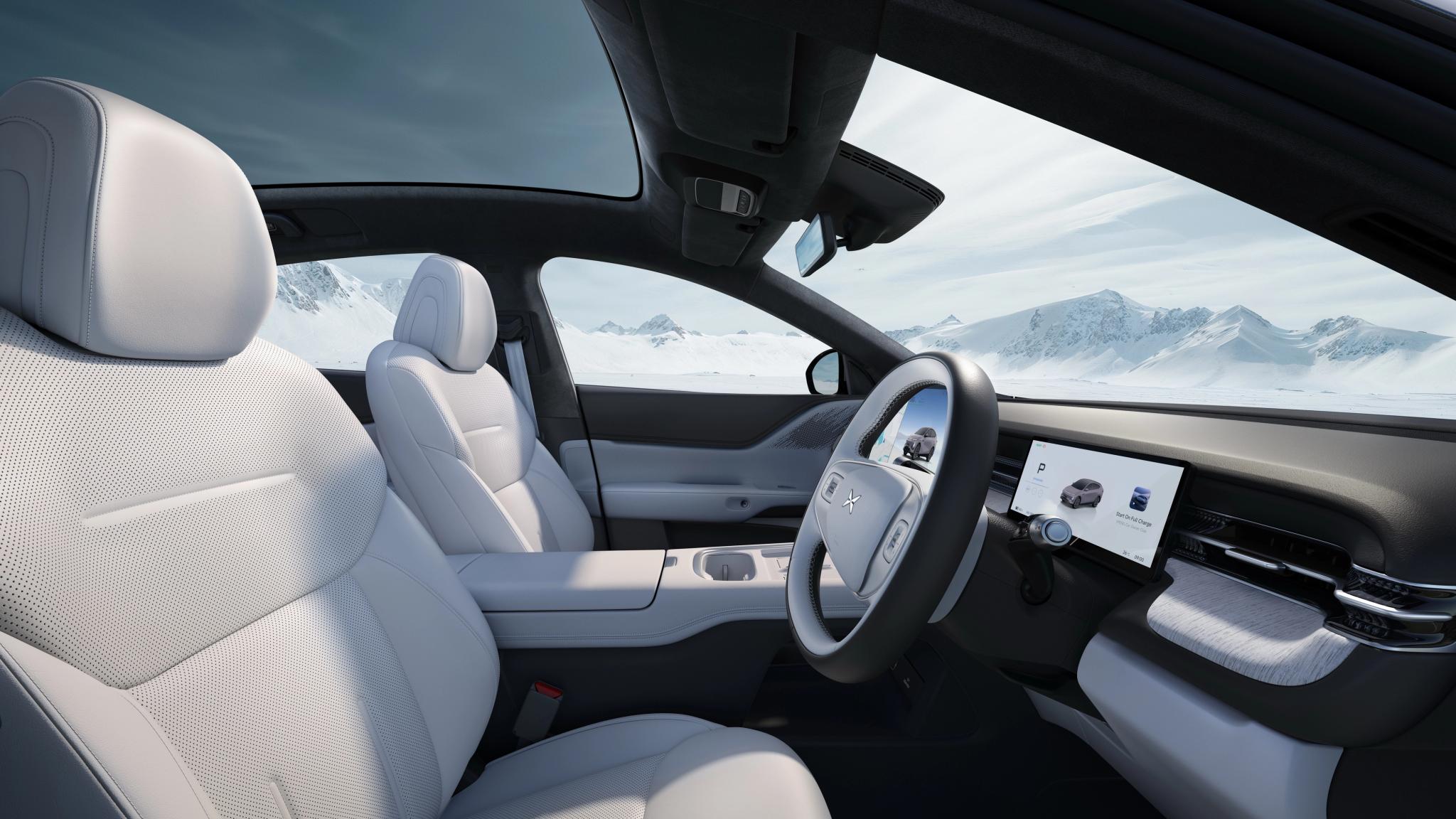
The 2026 XPENG G6 sits in a crowded Australian electric-SUV field with pricing from $51,800 before on-road costs, 480–525km WLTP range, and DC charging rated at 382kW or 451kW depending on version. The 80.8kWh Long Range reaches 525km, while the 358kW AWD Performance claims 0–100km/h in 4.13 seconds and 510km WLTP. All three use LFP batteries, an 800V electrical platform, and a claimed 10–80% charge in 12 minutes under suitable conditions. Compared with similarly priced 2026 rivals, the G6 stands out more for charging speed, cabin space and equipment than for battery size alone.
The Australian range starts with the RWD Standard Range at $51,800 before on-road costs. It uses a 68.5kWh gross LFP battery, produces 185kW and 440Nm, and reaches 100km/h in a claimed 6.94 seconds. Its WLTP range is 480km on 18-inch wheels or 470km on optional 20-inch wheels, showing how wheel size alone cuts the rated distance by about 2.1%.
That small wheel-related loss helps explain why battery capacity is not enough for a useful comparison. The Standard Range is rated at 16.6kWh/100km on 18-inch wheels, while the 20-inch setup raises consumption to 16.9kWh/100km. For a household covering 15,000km in a year, the official figures equate to roughly 2,490–2,535kWh of vehicle energy consumption before charging losses are considered.
The Long Range costs $56,800 before on-road costs and raises gross battery capacity to 80.8kWh, an increase of about 18% over the Standard Range. Output also rises to 218kW while torque remains 440Nm, cutting the claimed 0–100km/h time to 6.7 seconds. WLTP range reaches 525km on its standard 20-inch wheels, with official consumption listed at 17.9kWh/100km.
| 2026 G6 version | Price before on-road costs | Battery | WLTP range | DC peak | 0–100km/h |
|---|---|---|---|---|---|
| RWD Standard Range | $51,800 | 68.5kWh LFP | 480km* | 382kW | 6.94 sec |
| RWD Long Range | $56,800 | 80.8kWh LFP | 525km | 451kW | 6.7 sec |
| AWD Performance | $63,800 | 80.8kWh LFP | 510km | 451kW | 4.13 sec |
*480km with 18-inch wheels; 470km with 20-inch wheels.
The $5,000 step from Standard Range to Long Range buys 45km more WLTP range on the quoted standard-wheel figures, a 33kW increase in power, and a rise in maximum DC input from 382kW to 451kW. The price increase is about 9.7%, while gross battery capacity increases by roughly 18%, making the Long Range easier to justify for owners who regularly leave metropolitan areas.
Charging performance changes the way the 525km figure should be viewed. XPENG rates both the Long Range and AWD Performance for 451kW maximum DC charging, with 10–80% claimed in 12 minutes under suitable charger and battery conditions. The Standard Range is also rated for a 12-minute 10–80% session despite its lower 382kW peak.
A peak figure is not an average charging rate. Battery temperature, starting charge, charger output and the charging curve all affect what an owner sees at a public site. XPENG's Australian configurator explicitly notes that the 12-minute figure can vary with ambient temperature, battery condition and charger type, so a 150kW public charger will not reproduce a 451kW laboratory or high-output-station result.
That limitation also applies to competitors, making charging architecture worth comparing alongside range. CarExpert recorded 18.4kWh/100km during mixed driving of the AWD Performance, very close to XPENG's official 18.4kWh/100km figure, in a 2026 pre-release test that included high-speed German autobahn sections and air-conditioning use. The same vehicle carries a 510km WLTP rating.
Performance adds another comparison point. The AWD version uses two motors producing 358kW and 660Nm, versus 218kW and 440Nm for the Long Range. Its 4.13-second 0–100km/h claim is about 38% quicker than the Long Range's 6.7 seconds, yet official range falls by only 15km, from 525km to 510km.
At $63,800 before on-road costs, the AWD Performance also sits almost level with the 2026 BYD Sealion 7 Performance at $63,990 before on-road costs. The Sealion 7 uses a larger body at 4830mm long and offers a 500-litre rear boot plus a 58-litre front compartment, while the G6 provides 571 litres behind the second row but no front luggage compartment.
Cabin measurements therefore matter as much as exterior length. The G6 measures 4758mm long, 1920mm wide and 1650mm high, with five seats and a flat rear floor. Boot volume expands from 571 litres to 1,374 litres with the rear seats folded, giving it 71 litres more quoted rear cargo space than the Sealion 7 with all seats in use.
Payload is another figure often missed in EV comparisons. XPENG lists 470kg for the Standard Range, 475kg for the Long Range and 470kg for the AWD Performance. Five 80kg occupants would therefore leave roughly 70–75kg for luggage, so families carrying five adults, suitcases and accessories should check the gross vehicle mass rather than relying only on the boot-volume figure.
Inside, every 2026 version uses a 15.6-inch central touchscreen and a separate 10.25-inch digital instrument display. Wireless Apple CarPlay and Android Auto are available, while the published equipment includes seven airbags, adaptive cruise control, lane centring, blind-spot monitoring, rear cross-traffic alert, automatic parking functions and a surround-view camera.
Physical controls are limited because many functions sit in the centre display. That layout will suit drivers already used to screen-based EV interfaces, but it deserves attention during a test drive because temperature, vehicle settings and assistance functions can require touchscreen interaction. The panoramic roof uses glass that XPENG states provides 99.99% UV protection, although the manufacturer still recommends considering a shade during very hot Australian conditions.
For shoppers comparing an ev suv australia, price positioning is unusually close between brands. The 2026 BYD Sealion 7 Premium is listed at $54,990 before on-road costs, only $1,810 below the G6 Long Range, while the Sealion 7 Performance at $63,990 is $190 above the $63,800 G6 AWD Performance.
Tesla sits higher on current list pricing. The 2026 Model Y Rear-Wheel Drive was listed at $58,900 when new, roughly $7,100 above the G6 Standard Range's before-on-road figure. Carsales places indicative Model Y RWD drive-away pricing around $61,693–$65,767, although state charges and dealer-related costs prevent a clean drive-away comparison with XPENG's national list price.
The Model Y has a larger quoted luggage figure: CarExpert cites 938 litres against the G6's 571 litres, although manufacturers can use different measurement methods. The G6 counters with a conventional 10.25-inch instrument display ahead of the driver and substantially higher advertised DC peak rates; a buyer should compare actual charging curves rather than 451kW versus another manufacturer's single peak number.
Kia offers another reference point. The 2026 EV5 Air Long Range was listed at $61,170 when new, compared with $56,800 for the G6 Long Range, a difference of $4,370 or about 7.7%. Carsales quotes a 555km estimated WLTP range for the EV5 Air Long Range, 30km above the G6's 525km, so the Kia offers more rated distance while the XPENG places greater emphasis on high-output DC charging.
Home charging produces a different comparison because all G6 versions are capped at 11kW AC. XPENG quotes 5–100% AC times of 7.3 hours for the 68.5kWh Standard Range and 9.2 hours for both 80.8kWh versions. An owner charging overnight will therefore see little practical benefit from the 451kW DC hardware until using compatible public infrastructure.
Vehicle-to-load support adds another use case. XPENG lists up to 6kW V2L output for the Long Range and Performance, allowing suitable external electrical equipment to draw power from the traction battery. A 1kW appliance running for three hours would use around 3kWh before conversion losses, roughly 3.7% of an 80.8kWh gross battery.
Ownership coverage has also changed for the 2026 model. XPENG Australia now provides a seven-year, unlimited-kilometre vehicle warranty, an eight-year/160,000km high-voltage battery warranty and seven years of roadside assistance. Scheduled servicing is required every 12 months or 15,000km, so a driver covering 30,000km annually could reach the distance interval about twice as often as an average 15,000km-per-year owner.
The local support network is still younger than networks operated by long-established manufacturers. XPENG ANZ said in July 2026 that it planned up to 50 Australian sales outlets and three flagship experience centres, with most customers targeted to be within a 40-minute drive of a showroom. It also reported an operational genuine-parts warehouse in Melbourne and participation in Australia's motor-vehicle information scheme.
Range claims still need to be read as laboratory comparisons rather than guaranteed road distance. XPENG states that WLTP results can change with speed, passenger count, load, outside temperature, air-conditioning, terrain and vehicle condition. A 525km rating therefore gives a useful standard for comparing 2026 models, but an owner travelling at sustained motorway speeds in hot weather should leave a larger charging margin.
For mostly urban use, the $51,800 Standard Range already provides 480km WLTP, 185kW, a 571-litre boot and the same basic cabin dimensions as the more expensive versions. Spending another $5,000 on the Long Range raises rated distance by 9.4% and adds the 451kW charging ceiling, while avoiding the $7,000 step from Long Range to AWD Performance.
The Performance version makes more sense when AWD traction and acceleration matter enough to justify that increase. Its 358kW output is 64% higher than the Long Range's 218kW, but both use an 80.8kWh LFP battery and both claim a 12-minute 10–80% charge. Buyers focused on motorway distance receive 15km more WLTP range from the cheaper Long Range.
For Australian family use, the measurable trade-offs are therefore easy to test during a showroom visit: 470–525km WLTP depending on wheel and version, 470–475kg payload, 571 litres of luggage space, 11kW AC charging, up to 451kW DC charging and prices from $51,800 to $63,800 before on-road costs. The Long Range offers the broadest balance on paper at $56,800, with 525km WLTP and the full 451kW DC specification without paying for the 358kW AWD system.