A consumer product can pass a sample review and still arrive with a different finish, accessory set, label, or protective package if those details were never controlled together. Buyers can reduce avoidable mismatches by identifying the exact model and revision, approving both the product and its packaging, recording measurable acceptance points, and checking production against those records before dispatch.
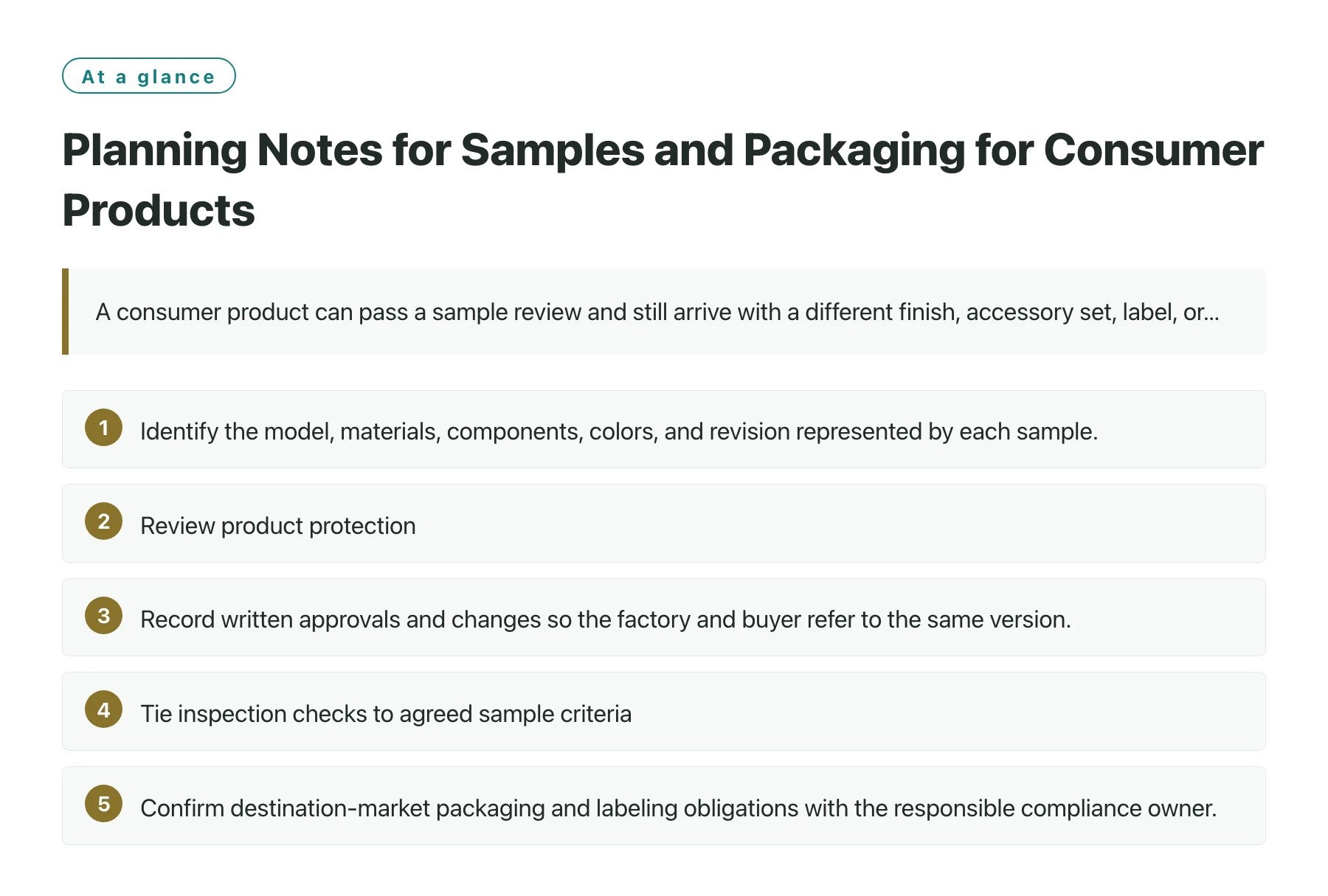
Key takeaways
- Identify the model, materials, components, colors, and revision represented by each sample.
- Review product protection, retail presentation, labels, carton configuration, and transport handling as separate requirements.
- Record written approvals and changes so the factory and buyer refer to the same version.
- Tie inspection checks to agreed sample criteria, order quantity, and packaging configuration.
- Confirm destination-market packaging and labeling obligations with the responsible compliance owner.
A sample is a decision tool, not a complete production control by itself. A clear approval record connects what was evaluated to what the purchase order requires.
Decide what the sample must answer
Before requesting a sample, write down the decisions it needs to support. A prototype might confirm dimensions and fit, while a pre-production sample can confirm materials, finish, accessories, assembly, and packaging. Those are different purposes. Label each sample accordingly and state whether it is for appearance review, functional evaluation, market compliance, packaging approval, or a combination. This prevents a visually attractive early prototype from being mistaken for the final production standard.
Identify the product model, factory, revision, color, material, component list, and date on the sample record. Photograph both the overall item and details that are hard to describe, such as surface texture, seam placement, connector shape, or included accessories. If a sample contains temporary parts or hand-finished details that will not be used in production, record them explicitly and request a representative replacement before final approval.
Buyers planning supplier selection and broader product sourcing can Learn more about the coordination process. For the sample itself, keep the decision narrow: what evidence does this physical unit provide, which requirements remain untested, and who is authorized to approve it? A short written answer helps purchasing, product, quality, and compliance teams avoid treating silence as acceptance.
Make approval criteria observable
Convert subjective preferences into references wherever practical. A color can be compared with a signed swatch under agreed lighting; a dimension can be measured at a defined point; a closure can be opened and shut; a printed panel can be checked against an approved file. State acceptable variation only when the product owner can explain why that range is suitable. Where no numerical limit is available, name the reference sample or visual standard and describe how reviewers will resolve borderline cases.
Use an approval sheet that separates accepted characteristics from open questions. For example, the main body may be approved while an instruction leaflet, warning label, accessory, or carton insert remains pending. Each decision should identify the reviewer, date, sample identifier, and any conditions. Keep notes specific: “approved subject to revised bilingual label proof” is more useful than “looks good.” Do not let one approval silently cover features that were not examined.
When several suppliers submit alternatives, evaluate them against the same criteria and record the actual configuration of each offer. A different resin, fabric, coating, battery, plug, or accessory can affect appearance, use, safety evidence, packaging, or price. Ask each supplier to identify substitutions rather than relying on catalogue names that may describe a product family rather than the quoted unit.
Design packaging around its job
Packaging usually serves several purposes: protecting the item, enabling storage and handling, presenting the product at retail, carrying required information, and grouping units for transport. List these functions separately. A consumer-facing box may need to communicate product identity and instructions, while an inner protective layer prevents abrasion and an outer carton supports warehouse handling. Optimizing one layer alone can create problems in another, such as a compact retail box that leaves fragile parts exposed during shipment.
Describe the packaging bill of materials and configuration: material types, inserts, bags, labels, manuals, protective corners, unit count, carton dimensions, gross weight, and pallet pattern where applicable. Mark the artwork version and identify who supplies and approves each file. For products with multiple colors or kits, make clear how variants are distinguished and how components are packed together. Request a packed sample when assembly or fit inside the carton could change the product condition.
Packaging rules can differ by destination and product category. The European Commission’s packaging and packaging-waste information describes EU policy and the Packaging and Packaging Waste Regulation; importers serving that market should check current obligations with their compliance owner rather than assuming that a package accepted elsewhere is sufficient. [1] Keep regulatory review separate from supplier claims and document which market, packaging layer, and product version were assessed.
Check how the packed product behaves
Review packaging with the actual product, not just a flat artwork proof. Confirm that the item fits without pressure on vulnerable parts, surfaces are separated where needed, small components remain contained, and labels can be read after packing. Consider the planned storage and handling path: stacking, repeated movement, temperature or moisture exposure, and the equipment used by the warehouse or carrier. The appropriate checks depend on the product and route; buyers should agree them with qualified packaging or logistics personnel.
Inspect a packed sample for assembly sequence, access to instructions, tamper evidence where specified, and the ability to identify the correct version. If a test is required, define the method, sample conditioning, acceptance criteria, and who interprets the result before ordering. A single successful trial applies to the tested configuration and conditions. It does not establish performance for a different carton, product weight, supplier, or shipping route.
Consider whether the packaging makes damage visible and whether receiving teams can count and identify units efficiently. Clear carton marks, SKU or model references, lot identifiers, and quantities can support warehouse checks. Avoid adding claims, symbols, or handling marks without checking their meaning and destination requirements. Keep the approved artwork and the physical packed sample together in the product file.
Connect the approved sample to production
Put the final sample identifier, drawings, artwork files, and approved bill of materials into the order documents or controlled attachments. The purchase order should specify the version being produced, quantity and variants, pack-out, labels, inspection criteria, delivery point, and any documents due before release. If a specification is too long for the order itself, refer to a uniquely named revision and make sure both sides can retrieve it.
Create a change process before production begins. Require written review for changes to materials, components, dimensions, supplier site, artwork, packaging, or process steps that could affect the approved result. The change request should explain the reason, affected orders, sample or test evidence, timing, and commercial effect. Update the controlled record after approval and inform purchasing, quality, logistics, and receiving teams.
Choose checks that reflect the product risks and order. Depending on the item, they may include identity, dimensions, function, appearance, accessories, label version, carton contents, and packing method. Define how sampling is selected, what counts as a defect, who can decide disposition, and what evidence is retained. An inspection report should describe what was examined and the outcome; it should not be represented as certainty about every unit beyond the agreed method.
Plan dates and responsibilities around approvals
Work backward from the required arrival date and include time for sample transit, review, revisions, artwork approval, material procurement, production, inspection, packing, export handoff, transportation, import processing, and receiving. Ask the supplier which dates depend on buyer decisions and how a missed approval affects the schedule. Avoid treating a quoted manufacturing lead time as the whole door-to-door timeline.
Name one owner for product approval, one for packaging artwork, one for regulatory review, and one for release decisions. Suppliers should know where questions go and what evidence is needed to close them. If a buyer has multiple teams or markets, consolidate comments before sending revisions so the supplier does not receive conflicting instructions.
At dispatch, compare the released order with the approved product and package records. Reconcile quantities, carton counts, packing list, inspection disposition, and transport booking. At receipt, record shortages, visible damage, or mismatched labels while the relevant packaging and shipment records are available. This creates a usable trail for resolving exceptions and improving the next order.
Keep a compact, usable approval file
A practical product file can contain the supplier and site identity, model and revision, sample log, signed approval, drawings, component list, packaging bill of materials, final artwork, test records, inspection plan, change approvals, and shipment documents. Use descriptive filenames and dates. Store superseded versions separately from the current approved set so a reviewer does not mistake an old proof or prototype for the production standard.
After delivery, compare complaints, return reasons, damage, missing parts, and receiving delays with the assumptions made during sample and packaging review. Tie each observation to the product revision, order, lot, and known handling conditions. Use those findings to update the next specification. A disciplined feedback loop improves the next purchasing decision without turning one shipment into a broad claim about an entire product category or supplier.
Sources
Frequently asked questions
Should product and packaging samples be approved separately?
Review them as distinct decisions, then record how the approved package contains and identifies the approved product. A combined packed sample can confirm the interaction between them.
What should a sample approval record include?
Include supplier, model, revision, sample purpose, date, reviewer, accepted features, open items, reference photos or files, and any conditions or changes required before production.
Does a successful packaging trial prove every shipment will arrive undamaged?
No. It only provides evidence for the tested product, package, method, and conditions. Keep production checks and route-specific handling considerations in the plan.
Who is responsible for destination-market packaging requirements?
The importer or product owner should identify a qualified compliance owner for each market and confirm which product and packaging versions were reviewed.