Lipstick Shade Matching: A Batch-to-Batch Workflow
Shade matching is not one decision, it is a sequence of four: agree the reference, approve a sample, fix the tolerances, then hold a retained sample against every later batch. Brands that skip the fourth step discover drift months later, when a reorder arrives visibly different from the first run. Inside a published four-to-eight-week route, the shade work has to be scheduled rather than assumed.
Key takeaways
- Fix one physical reference shade and one lighting condition before any sample is poured.
- Pigment dispersion decides whether a repeat batch lands on the reference or drifts away from it.
- Agree a colour-difference tolerance in writing; "close enough" is not a specification.
- Shade rounds consume the production window, so two rounds can eat most of a four-week route.
Step one: agree the reference
Everything downstream depends on a physical standard: a bullet, a poured chip or a coated card that both sides hold. A photograph is not a reference, because screen calibration changes the target between the two parties. Send the physical sample, keep a duplicate, and record the light under which it was judged.
Daylight and a studio lamp show a red differently, and a buyer comparing an indoor sample with an outdoor photograph will always find a disagreement. Naming the viewing condition in the specification avoids arguments that are really about illumination.
Step two: approve a sample against the reference
The sample round exists to test the formula and the shade together. A base that looks correct on a chip can read differently once it is moulded, because the surface finish changes how light leaves the bullet. That is why approval should happen on a finished, cooled bullet rather than on the bulk.
Ask for the sample in the case you intend to use. The sleeve and the finish interact with the shade in the same way the base does, and a sample judged in a generic shell may not survive the switch to your own pack.
Step three: write the tolerance down
A specification that says "match the reference" leaves every party room to disagree later. Agree a numeric colour-difference limit instead, and state where it is measured — on the bullet surface, on a drawdown, or both. Once the number is in the specification, batch approval stops being a matter of taste.
Set the limit with the packaging in mind as well. A high-gloss finish hides small differences that a matte finish exposes, so the same tolerance can be generous for one product and tight for another.
| Item | Published figure | Why it matters to shade work |
|---|---|---|
| Existing-formula route | 4–8 weeks | The whole shade sequence has to fit inside it |
| New development route | 3–6 months | More room, but a new base can shift the shade |
| Formula library | 10,000+ mature formulas | Starting from a proven base shortens matching |
Step four: hold a retained sample
The retained sample is what makes a reorder repeatable. Keep the approved bullet, its batch reference and the agreed tolerance together, then ask that each new batch be compared against that physical standard rather than against a description in an email.
Retention also protects the supplier. When a brand reports drift, the first useful document is the reference bullet from the approved run — without it, both sides are comparing a new sample against their memory of the old one.
Where shade work usually goes wrong
The most common failure is approving on a drawdown and filling from a mould. A drawdown is flat and a bullet is curved, so the same pigment paste can read slightly darker or lighter once it is moulded. Approving the moulded form removes the argument before it starts.
The second is a change of base after shade approval. Swapping an emollient or a wax alters how the pigment disperses, and the shift shows up in the finished colour rather than in the bulk. If the base has to change, treat the shade as unapproved until a new bullet is signed off.
The third is silence on tolerance. A brand that says nothing about acceptable difference is effectively accepting whatever arrives, and a supplier who is never told the limit cannot measure against it.
Worked example: how many shade rounds fit the window
Take the published four-to-eight-week route, which is 28 to 56 days. Suppose a shade round — pour, cool, send, review, respond — takes about ten days including transit. Two rounds cost 2 × 10 = 20 days, leaving 28 − 20 = 8 days of the shortest route for everything else: bulk preparation, filling, inspection and packing. On the eight-week route the same two rounds leave 56 − 20 = 36 days, which is comfortable.
The arithmetic is mine and the ten-day round is an assumption you can replace with your own transit times. What does not change is the conclusion: on the fast route, a second shade round is the difference between a launch and a delay, so tighten the reference before the first sample rather than after the second.
Reading the checkpoints chart
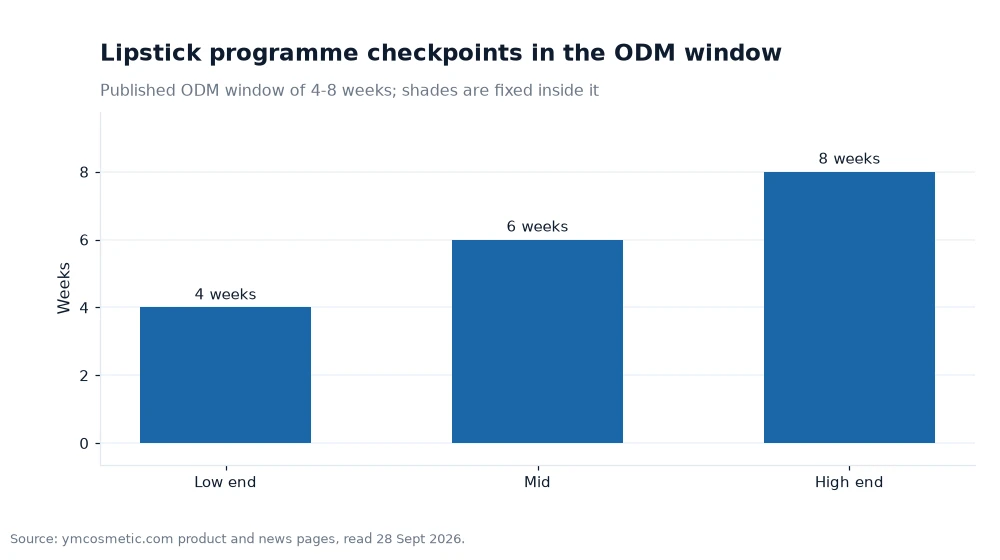
Read as a schedule, the bars say where shade approval has to land: inside the first half of the window, or the fill and the packing push past the other end. Brands that treat colour approval as an early task rather than a final one almost always launch on the shorter route.
Frequently asked questions
How close can a shade be matched to an existing product?
Close enough that a colour-difference tolerance agreed in writing is the practical standard, rather than a promise of an exact match. Pigment suppliers, base lots and surface finish all introduce small differences, which is why the tolerance matters more than the target.
Should the reference be a bullet or a colour chip?
A finished bullet is the better reference for a moulded product, because the surface changes how the colour reads. Keep a chip as well if your designer works against printed references, but decide which one governs when the two disagree.
What causes a repeat batch to drift?
Pigment lot changes, base lot changes and process differences in dispersion or cooling. A retained sample plus a stated tolerance turns each of those into a measurable comparison rather than an opinion.
Making the workflow routine
Reference, sample, tolerance, retained sample — four steps that take one meeting to set up and save a production round later. If you are still comparing suppliers, ask each of the private label lipstick manufacturers on your list how they record a reference shade and how often they issue a repeat batch against it. Yunmei's OEM/ODM manufacturing overview describes the formula and sample stages that sit either side of shade approval, and the eye cream ingredient guide is a useful contrast for brands carrying colour and skincare in one range.
Ymcosmetic.com supplies the development windows, formula library size and process steps referred to above — read on 28 Sept 2026. My own assumptions are the ten-day shade round and the schedule arithmetic built on it, stated so you can substitute your transit times.[1].