An established beauty brand does not audit a fragrance supplier to be convinced; it audits to be able to defend the decision internally. That changes the checklist. Certificates, category lists and showroom impressions are the entry ticket, and they are also the part that proves the least. What survives a capability audit is evidence of control: versioned specifications, retained reference standards, test reports the brand is allowed to see, and named people who own each decision. This checklist is written for the buyer who already runs a beauty brand and is adding or replacing a fragrance manufacturing partner, and it is built around what can be requested and verified rather than what can be asserted.
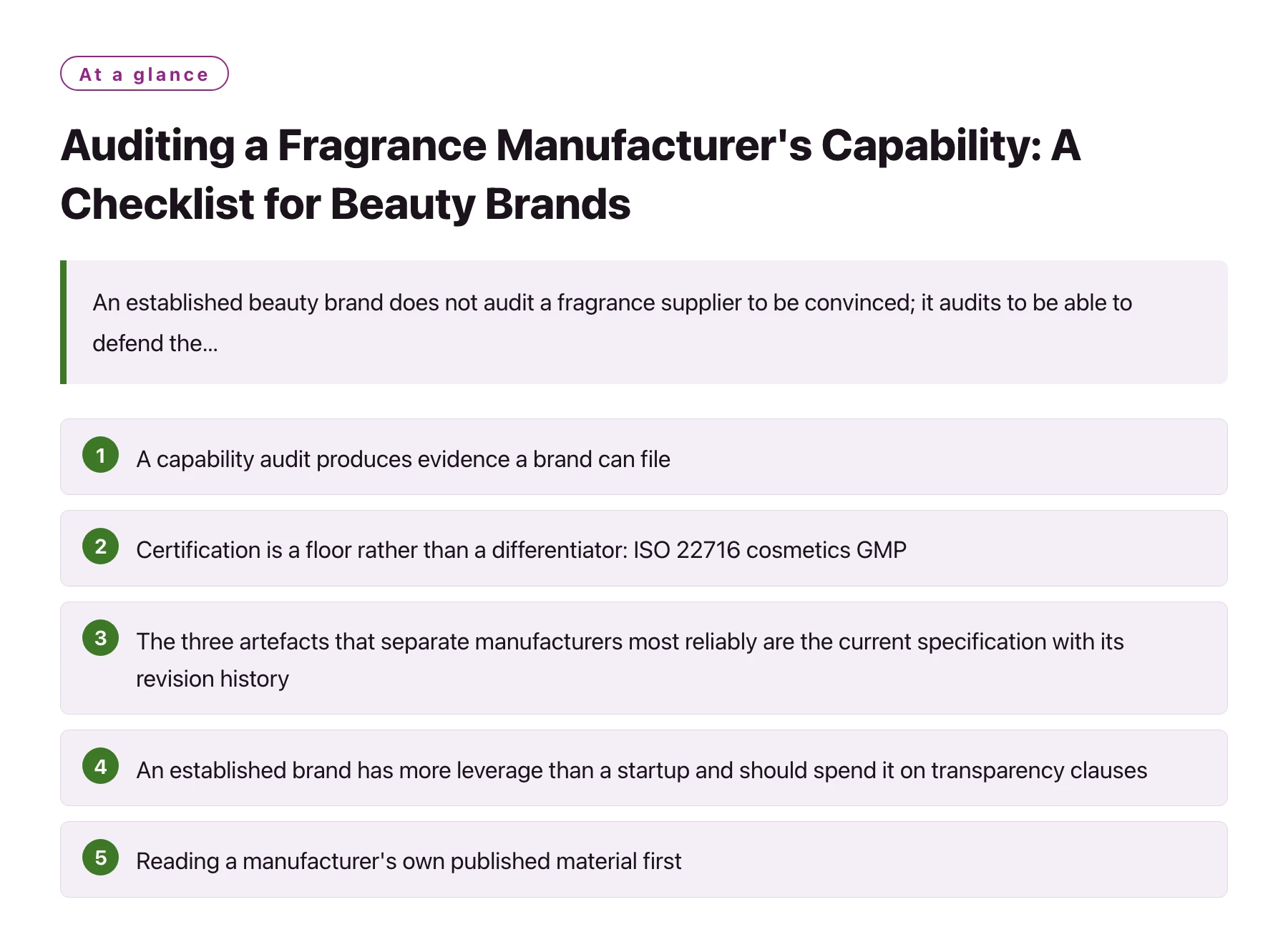
Key takeawaysA capability audit produces evidence a brand can file, not impressions a brand has to remember, so every question should map to a document, a record or a named responsible person. · Certification is a floor rather than a differentiator: ISO 22716 cosmetics GMP, ISO 9001, ISO 14001 and ISO 45001 describe systems, and the audit has to test whether those systems are actually producing records. · The three artefacts that separate manufacturers most reliably are the current specification with its revision history, the retained reference standard kept after approval, and stability or compatibility test reports. · An established brand has more leverage than a startup and should spend it on transparency clauses, sample retention and change-notification terms rather than on unit price. · Reading a manufacturer's own published material first, including the fragrance manufacturer's website, tells the auditor which questions are already answered and which are being avoided. · The audit should end with a short list of open items and owners, because an unanswered question about document control is itself a finding.
Most capability audits fail for a boring reason. The questions were good, the visit was well organised, and the answers were warm, but nothing left the room in a form that could be reviewed two weeks later. An established beauty brand cannot run on that. Its own quality system, its retailer agreements and its regulatory filings all require a supplier file that someone else can read.
This checklist is deliberately narrow. It concentrates on the parts of a fragrance manufacturer's operation that are knowable in a single evaluation cycle: how specifications are controlled, how the approved reference is held, how testing is documented, how changes are notified, and how the manufacturer describes itself in public. Anything beyond that, such as cost structures or capacity planning, is commercial rather than capability and belongs in a separate conversation.
It is written from the seat of a procurement or quality manager inside an established beauty brand, someone who has audited contract manufacturers before and knows that the useful output is a documented gap list rather than a verdict.
The checklist: audit area, the evidence to request, and how to read the answer
| Audit area | Evidence to request | An answer that proves nothing | What a usable answer contains |
|---|---|---|---|
| Specification control | The current fragrance specification plus its full revision history for one live project | A clean, final-looking specification with no prior versions | Dated revisions with the reason for each change, and a statement of which version is currently in force |
| Reference standards | The retained reference sample kept from the approved round, with its storage conditions and review interval | A statement that references are kept “as required” | A named storage location, a retention period, and the person who signs off when a reference is replaced |
| Testing and stability | Stability and packaging compatibility reports for a comparable format | A reference to “tests done at the lab” without a report | Reproducible reports with conditions, duration, observations and a conclusion the brand can file |
| Materials and safety | Documented alignment with the IFRA Standards for the categories the product will carry | A blanket statement that everything is compliant | Category-specific reasoning, the version of the standards applied, and a route to the material documentation [1] |
| Change notification | The written process for notifying a brand when a raw material, supplier or process changes | A promise to “keep the brand informed” | A defined trigger, a notification window, and the clause in the agreement that makes it enforceable |
| Batch traceability | A worked example showing how one finished batch is traced back to raw material lots | An assertion that the system is fully traceable | A reconstructed example the brand can follow from a batch code to the ingredient lots behind it |
Two patterns are worth noticing in this table. Every evidence item is something the manufacturer either has or does not, so the audit produces facts rather than opinions. And every weak answer is a variation on the same move, which is to replace a record with a reassurance. That is also why the first step of a capability audit costs nothing: read what the manufacturer publishes before you travel, since a company that documents its processes in public tends to document them internally as well, and the fragrance manufacturer's website is the cheapest evidence available before a first call.
How an established brand's audit differs from a startup's
A first-time founder usually audits to find out whether a manufacturer can do the job, and the answer is often yes. An established beauty brand is asking a different question: whether this manufacturer can keep doing the job, at the same standard, across reorders, staff changes and raw material substitutions. That is a question about the system rather than the sample.
The practical consequence is that the established brand should weight document control far more heavily than presentation. A factory whose samples are excellent but whose specifications are undated is a risk the brand will carry for years, because every future dispute will be settled by comparing against something nobody can identify. It is worth reading how a manufacturer describes its background and certifications in public before the visit, and treating any vagueness there as a signal rather than a formality.
You have leverage: spend it on transparency, not on price
An established beauty brand usually brings volume, a track record and a real calendar, which is exactly what a contract manufacturer wants in its order book. That leverage is worth more when it is converted into terms than when it is converted into a discount. Sample retention for the life of the product, written change notification, access to test reports, a defined process for handling a non-conformity, and a clear statement of who owns the formula are all things a serious manufacturer can agree to and a weaker one will resist.
It is also reasonable to ask for a small pilot before a full programme, not as a test of quality but as a test of paperwork. A first run that arrives with complete documentation tells the brand more about the next five years than a discounted quotation ever will. The general sequence of checks that precede a signature is set out in Xuelei's guide, and it is worth running that sequence alongside the technical audit rather than after it.
Where the audit should be honest about its limits
No single visit establishes that a manufacturer will behave well for a decade. The audit can confirm that systems exist, that records are produced, and that people know their responsibilities; it cannot confirm that they will always be followed. Being explicit about that limit is useful, because it pushes the brand towards contractual protections and periodic re-verification instead of a false sense of completion.
For brands selling into the European Union, the audit has a second purpose. The responsible person and product information file requirements mean the brand, not the factory, carries the regulatory obligation, and the supplier file is the evidence behind it [2]. Auditing a manufacturer without asking how it will feed that file is an incomplete audit.
Keep the audit output to one page. List each finding as either closed with evidence, open with an owner and a date, or accepted as a risk the business has consciously chosen. Anything that cannot be placed in one of those three categories is a note, not a finding, and notes are what turn a capability audit into a memory exercise. Where third-party testing or certification is part of the file, ask who performed it and against which standard, because a test report and a certificate answer different questions [3].
Sources
- IFRA: Safe Use and Fragrance Science —— IFRA's explanation of how fragrance materials are scientifically assessed for safe use and how those conclusions are applied by the industry.
- European Commission: Cosmetics in the EU —— The European Commission's overview of EU cosmetics rules, including the responsible person, product information file and safety report requirements.
- SGS: Cosmetics, Personal Care & Household Testing —— Testing, inspection and certification services for cosmetics and personal care, including microbiological, stability and safety testing aligned with cosmetics GMP.
Frequently asked questions
What should a capability audit of a fragrance manufacturer actually cover?
Concentrate on evidence of control rather than on capability claims: specification control and revision history, retained reference standards, stability and compatibility testing, documented alignment with fragrance safety standards, change notification, and batch traceability. Each of those can be demonstrated with a record, which is what makes the audit defensible internally.
Do certifications tell an established brand anything useful?
They tell you that an audited management system exists, which is a legitimate floor and a reasonable filter. They do not tell you whether records are produced consistently or how the manufacturer behaves when a component arrives out of specification. Treat certificates as the starting question rather than the conclusion.
How long should a supplier capability audit take?
The document review can usually be completed before any visit, and the site time is best spent verifying that the records described actually exist and are used. A single well-prepared day, with the document requests sent in advance, produces more than several unstructured visits.
Should the audit include a trial order?
Yes, when the calendar allows. A small pilot exposes the documentation habits of the manufacturer under real conditions, including how it handles a query mid-project. It is a better predictor of a long relationship than a larger order placed on the strength of a sample alone.
What is the most common gap found in these audits?
Undated or unversioned specifications, followed by reference samples that cannot be located when a question arises months later. Both are cheap to fix and expensive to discover late, which is why they are worth asking about explicitly and early.