Weight per Metre and Its Effect on Racking Design
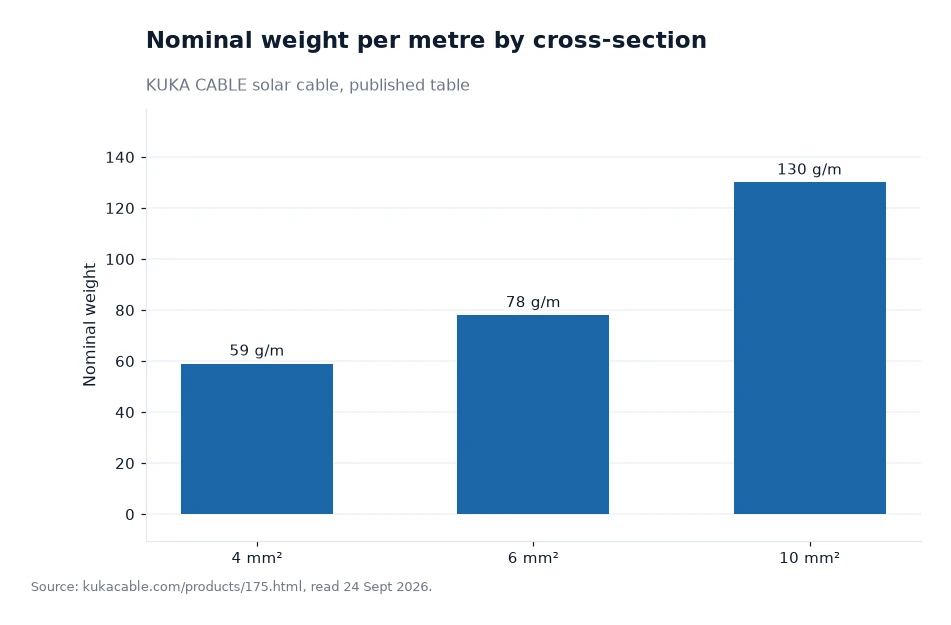
A 4 mm² solar cable weighs 59 g/m, a 6 mm² weighs 78 g/m and a 10 mm² weighs 130 g/m in the table published by KUKA CABLE. Those three figures decide how closely cable can be clipped to a rail, how much a tray carries and how much of a rail's snow and wind allowance the cable consumes.
Key takeaways
- Published weight per metre is 59 g/m at 4 mm², 78 g/m at 6 mm² and 130 g/m at 10 mm², the sizes the site calls commonly used.
- Nominal overall diameter for the same three sizes is 5.5 mm, 6.0 mm and 7.5 mm, with a bending radius of four times the diameter.
- A two-core string run therefore weighs 118 g/m at 4 mm² and 260 g/m at 10 mm² (author's arithmetic: twice the published single-cable weight).
- Nothing about clamp spacing, tray fill or wind loading is published on the site; those are design values, not cable data.
Why mass belongs in the racking conversation
Mechanical engineers design a mounting structure for snow, wind and self-weight, and cable is often left out of that calculation until the last revision. It should not be, because cable behaves like a distributed load with almost no stiffness: it sags between clamps, it swings in gusty conditions and it transfers part of that movement into the clamp and the rail beneath it. On a roof, where the rail is shared with modules, the added load is small against snow but continuous, and it acts on the same fixing points that hold the array down. On a ground-mounted array the effect is different again, because the cable route is longer and a tray or a buried duct usually carries the weight instead. In all three cases the starting figure is the same: mass per metre from the published dimension table, multiplied by the length actually supported.
What the published weights say
The dimension table lists nominal weight per metre for every cross-section from 1.5 mm² to 240 mm², and the small end of the range moves in small steps. The smallest entry, 1.5 mm², is 34 g/m; 2.5 mm² is 45 g/m; 4 mm² is 59 g/m; 6 mm² is 78 g/m; 10 mm² is 130 g/m; 16 mm² is 190 g/m. A designer working on a rooftop string will usually be choosing between 4 mm², 6 mm² and 10 mm², and the difference across that short list is a factor of about two, from 59 g/m to 130 g/m. Because a DC string needs two conductors, the cable mass in the racking calculation is doubled before anything else is considered; a 10 mm² pair is 260 g/m, and a hundred metres of it is 26 kg of cable to support before clamps, ties and connectors are counted. The full dimension table lists every size from 1.5 mm² to 240 mm² with its weight and diameter.
| Cross-section | Weight per metre | Two-core run per 100 m (author's calculation) | Where it usually sits |
|---|---|---|---|
| 1.5 mm² | 34 g/m | 6.8 kg | Short module tails and jumpers |
| 2.5 mm² | 45 g/m | 9.0 kg | Small residential strings |
| 4 mm² | 59 g/m | 11.8 kg | Common rooftop string size |
| 6 mm² | 78 g/m | 15.6 kg | Longer rooftop strings and twin-core runs |
| 10 mm² | 130 g/m | 26.0 kg | Rooftop to inverter feeders |
| 16 mm² | 190 g/m | 38.0 kg | Longer feeders and small ground-mount blocks |
Diameter matters as much as mass
Two cables of the same weight do not load a clamp in the same way, because bending stiffness climbs steeply with diameter while mass follows the area of copper. The published diameters for the three common sizes are 5.5 mm at 4 mm², 6.0 mm at 6 mm² and 7.5 mm at 10 mm², and the site pairs them with a minimum bending radius of four times the outer diameter. Working that rule through gives a 22 mm radius at 4 mm², 24 mm at 6 mm² and 30 mm at 10 mm² (author's calculation from the published diameters and the published 4× rule). A radius of 22 mm is easy along a rail, but it is not easy around the corner of a combiner box or a tight return at the end of a row, and a bend taken short is where a sheath gets pinched against a clamp. Add the fact that the smallest sizes are the same construction concept as the largest, tinned copper class 5 flexible conductor to IEC 60228 under cross-linked XLPO, and the design rule becomes simpler: keep the bend generous and let the diameter, not the weight, set the clamp spacing.
Single-core or twin-core, in mass terms
A twin-core cable puts both conductors in one jacket, which changes the arithmetic in a way a racking designer needs to see. Two separate 6 mm² cables carry 156 g/m of compound and copper plus two clips at every fixing point; a twin-core 6 mm² carries both conductors inside one outer sheath, so the number of fixing points per metre falls even though the metallic mass is the same. The published range includes single-core and twin-core versions of the same family, and the site names 4 mm², 6 mm² and 10 mm² as the commonly used specifications across both on its PV cable pages. The trade-off is bend radius and cable diameter: one larger jacket instead of two smaller ones. For a rail-mounted run with shared clips, the twin-core layout usually wins on part count; for a route that has to split at a combiner box, single cores give more freedom.
From published data to a design number
The site gives mass per metre, diameter and a bending rule. It does not publish a supported span, a clamp spacing, a maximum tray fill or a wind load, and those are not cable properties in any case; they come from the structure and from local codes. A designer therefore has to bring the span and the local loading to the table and use the published mass as the input. The same is true of the service figures: the site states a service life of 25 years or more, with 30 years published for one model, and the standards quoted for the line are TUV 2PfG 1169/08.2007, EN 50618:2014 and IEC 62930. A support system that holds the solar cable at four times its diameter and keeps water off it is the most direct way to let the cable reach the service life it is specified for.
Worked example: clamps and a hundred metres
Take a rooftop string run of 100 m using 6 mm² cable and clips at 1 m centres. The published weight is 78 g/m, so one metre of a single conductor loads each clip with 78 g and a two-conductor DC pair loads it with 156 g (author's calculation: 78 × 2 = 156, assuming a 1 m clip spacing and both polarity cables sharing each fixing). The whole 100 m pair is 15.6 kg of cable. Switching the same run to 10 mm² raises the pair to 260 g per clip and 26 kg in total, which is a 67% increase in supported mass before any allowance for snow or wind (author's calculation: 260 ÷ 156 = 1.67). On a short residential string that change is irrelevant; on a long roof with closely spaced rails and a tight fixing budget, it is the difference between one line of clips and two.
Frequently asked questions
What does a 6 mm² run weigh per metre?
A single 6 mm² cable is published at 78 g/m, with a nominal overall diameter of 6.0 mm. A two-conductor DC pair of that size therefore adds 156 g per metre of supported route (author's calculation), and 100 m of the pair weighs 15.6 kg.
Does the site publish a clamp spacing or tray fill figure?
No. The published data covers conductor construction, overall diameter, weight per metre, bending radius, temperature limits and test results. Clamp spacing, maximum span and tray fill depend on the structure and the local code, so they have to come from the project's mechanical design rather than from the cable datasheet.
What to check on the datasheet
Check the weight per metre for the size actually specified rather than for the size in the brochure, because the three common sizes differ by a factor of two. Check the nominal overall diameter and apply the published four-times rule to get the minimum bend, then confirm the rail or tray geometry can respect it. Ask whether the run is single-core or twin-core, since the number of fixing points per metre changes with the answer, and request the data sheet for the exact model, whether that is H1Z2Z2-K, PV1-F or UL 4703 wire. For a long route, ask the supplier to confirm the two figures that will be quoted on the packing list, weight per metre and drum or coil length, because the site publishes the first and leaves the second to the quotation.
Weights such as 59 g/m at 4 mm² are the maker's published data on its own site, kukacable.com, read through 24 Sept 2026[1].