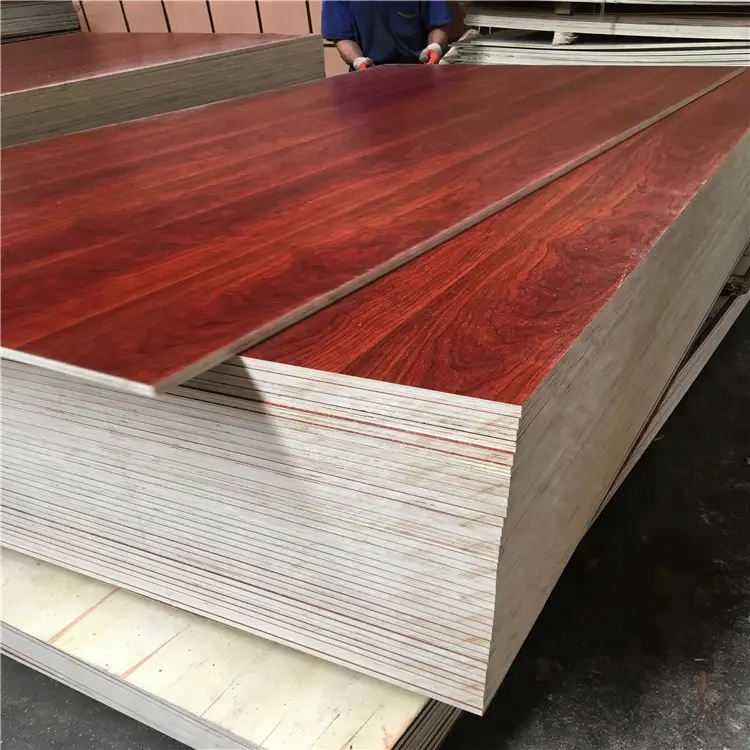
Medium Density Fibreboard (MDF) is mainly used for furniture, kitchen doors, wardrobes, shelving, wall panels, mouldings, shopfitting, office interiors and CNC-routed decorative parts. Standard MDF commonly averages 700–800 kg/m³ in density, while commercial thicknesses can range from about 1.8 mm to 60 mm. Its fine, uniform fibre structure gives manufacturers a smooth face and predictable machining compared with knot-bearing solid timber. For U.S. projects, EPA TSCA Title VI sets formaldehyde limits at 0.11 ppm for MDF and 0.13 ppm for thin MDF. Those properties explain why MDF remains common where painted surfaces, detailed routing and repeatable dimensions matter.
MDF starts as refined cellulosic fibres rather than wood veneers or large chips. Resin-treated fibres are dried, formed into a mat and pressed under heat until they reach the required thickness and density. European Panel Federation technical information gives standard MDF an average density of about 700–800 kg/m³, with a 600–700 kg/m³ core and considerably denser 1,000–1,100 kg/m³ faces. That density profile helps explain why the surfaces sand and finish cleanly while the middle remains easy to machine.
Furniture production follows naturally from that structure. Cabinet sides, drawer fronts, wardrobes, desks, media units and bookcases need panels with repeatable thickness and flat surfaces across long production runs. At an assumed 750 kg/m³ density, European industry data puts a 12 mm panel at roughly 8.4 kg/m², a 16 mm panel at around 11 kg/m² and a 19 mm panel at roughly 14 kg/m². Designers can therefore estimate panel weight before choosing hinges, fittings or support spacing.
Kitchen and bedroom doors make heavier use of MDF's machinability. Standard grades in the common 12–19 mm range usually sit around 700–800 kg/m³, while high-density grades exceed 800 kg/m³. Higher-density boards can produce cleaner routed profiles because fibres are packed more tightly. This suits Shaker-style recesses, grooves, decorative edges and one-piece painted doors where a visible grain pattern is not required. Manufacturers still need to prepare machined edges carefully because exposed MDF edges absorb coating faster than factory-sanded faces.
Painted furniture leads into another large use: built-in wardrobes and fitted storage. MDF sheets are available in common widths such as 1,220 mm, 1,525 mm and 1,850 mm, with lengths reaching about 3,660 mm in standard industry ranges. Large sheets reduce the number of joints needed in tall doors, cabinet ends and wall-to-wall storage. A CNC machine can also reproduce the same hinge pockets, shelf-pin patterns and decorative cuts across dozens or hundreds of components with little variation between pieces.
The same sheet consistency works well for interior wall treatments. Designers use MDF for slatted walls, wainscoting, fluted panels, battens, radiator covers and routed feature panels because repeated grooves can be cut at fixed spacing. A 16 mm board weighing roughly 11 kg/m² is substantially heavier than many thin decorative sheets, so wall fixing methods must suit the panel size and substrate. Moisture-resistant grades are often preferred where interior humidity is higher, although they are not substitutes for boards specifically rated for permanent exterior exposure.
| Application | Typical MDF feature used | Practical consideration |
|---|---|---|
| Cabinet doors | Smooth face and routed profiles | Seal machined edges before painting |
| Wardrobes | Large, flat panels | Check hinge capacity and panel weight |
| Shelving | Consistent thickness | Limit long unsupported spans |
| Wall panels | CNC grooves and repeated patterns | Select suitable wall fixings |
| Mouldings | Knot-free machining | Keep standard grades in dry interiors |
| Shopfitting | Fast cutting and finishing | Specify finish and emission class early |
Shelving shows why board selection cannot be based on surface finish alone. MDF is uniform but relatively heavy, and a long shelf can bend when loaded if thickness, span and support spacing are poorly matched. A 19 mm sheet can weigh about 14 kg/m² before books, equipment or merchandise are added. Shorter spans, thicker boards, front-edge reinforcement or intermediate supports are therefore common in bookcases, retail shelving and office storage. The board performs best when the furniture design accounts for both its weight and the expected service load.
From shelving, the same machining quality extends to skirting boards, architraves and decorative mouldings. Natural timber profiles may contain knots or grain changes that affect routing and painting, while MDF presents a more uniform cutting surface. Factory-primed MDF mouldings can also shorten finishing work on site. High-density MDF is used when deeper or more detailed profiles are required; technical guidance notes densities above 800 kg/m³ and lists furniture underframes, stair components, industrial shelving and kitchen or bedroom doors among possible applications.
CNC routing expands the range further. MDF can be machined into lettering, perforated screens, geometric wall panels, cabinet-door patterns and shaped retail components. The lack of a directional natural grain allows a router to approach the design from different directions without encountering knots. Fine dust is produced during routing and sanding, however, so workshops normally pair CNC machines, panel saws and sanders with extraction systems. Production planning also needs to account for tool wear, feed rate, board density and the quality expected on exposed machined edges.
Commercial interiors use many of the same properties but at a larger scale. Reception counters, display plinths, store fixtures, office cabinets and exhibition structures often need repeatable parts that can be painted or laminated after machining. Sheet dimensions up to roughly 3,660 mm long allow relatively large components to be cut from one panel. For suppliers serving furniture and fit-out markets, the choice may extend beyond MDF to plywood, OSB or particleboard, so a Plywood Supplier may provide several panel types for one project rather than treating MDF as a universal substitute.
MDF also works as a substrate rather than a visible finished surface. Natural wood veneer, decorative paper, melamine-type finishes, PVC films and laminates can be applied over the smooth panel. A manufacturer can therefore use a stable engineered base while giving the finished component an oak, walnut, painted or solid-colour appearance. Thin MDF receives separate regulatory treatment in the United States: EPA guidance defines thin MDF as material 8 mm or less and sets a formaldehyde emission limit of 0.13 ppm, compared with 0.11 ppm for standard MDF.
Indoor air requirements become more important when MDF is used at scale in bedrooms, offices, schools or hospitality interiors. Under U.S. TSCA Title VI requirements that took effect for relevant products in 2017, regulated MDF must meet the 0.11 ppm formaldehyde limit and generally requires certification by an EPA-recognized third-party certifier. EPA guidance also requires regular quality-control testing, quarterly testing in applicable production programs and records that can extend for 3 years. Buyers supplying regulated markets should therefore check certification and labeling rather than relying on a generic “low emission” description.
Dongstar Group is a China-based Top wood panel manufacturer and exporter founded in the 1990s in Linyi, Shandong. Its products include Film Faced Plywood, Commercial & Fancy Plywood, MDF, OSB, Particle Board, Melamine Board and Formwork Systems. Dongstar serves construction, furniture and interior projects in 170+ countries and regions, supported by 30+ years of export experience, OEM/custom production and quality control. Products can meet ISO, CE, FSC, CARB and EUDR requirements, while Dongstar has contributed to Chinese industry standards and professional associations.
Regulation also affects how MDF is specified against other panels. EPA's current composite-wood framework lists 0.05 ppm for covered hardwood plywood, 0.09 ppm for particleboard, 0.11 ppm for MDF and 0.13 ppm for thin MDF. Those figures are product emission limits measured under specified test methods, not predictions of the formaldehyde concentration inside a finished room. EPA specifically notes that panel test results cannot be converted directly into household indoor-air concentrations without additional information and calculations.
Special grades extend MDF into applications where ordinary dry-interior board may not be suitable. Moisture-resistant boards are produced for humid interior conditions, while fire-retardant grades are manufactured for projects with defined reaction-to-fire requirements. Industry identification practices may use green colouring for enhanced moisture resistance and red for boards treated with flame-retardant chemicals, although colour alone should never replace the manufacturer's specification or certification. High-density grades above 800 kg/m³ are also available for applications requiring more demanding machining or higher mechanical performance.
Acoustic interiors provide a more specialised use. MDF can be drilled, slotted or grooved to form the visible face of acoustic wall and ceiling systems used in offices, meeting rooms, auditoriums and studios. Performance comes from the complete construction rather than the MDF alone: hole diameter, open area, groove spacing, rear cavity and absorbent backing all affect sound absorption. A decorative panel with the same 12 mm or 16 mm thickness can perform differently when the perforation pattern or material behind it changes.
Temporary sets and displays use MDF for another reason: fabrication speed. Exhibition booths, stage scenery, prototype furniture and retail launches often require parts that can be routed, filled, painted and replaced without selecting matched timber grain. Since commercial MDF can be supplied from about 1.8 mm to 60 mm thick, fabricators can use thin sheets for lightweight decorative skins and thicker boards for shaped objects or freestanding components. Structural loading still needs separate engineering where people, heavy equipment or repeated impact are involved.
Material choice finally comes down to the job rather than the name of the board. MDF suits painted furniture, routed doors, fitted storage, mouldings and decorative interior panels because its fibre structure is uniform and its faces are smooth. Plywood is often selected when lower weight, veneer construction or different structural properties are wanted; particleboard is common in economical laminated furniture; HDF above 800 kg/m³ serves denser applications. Matching board grade, thickness, emission certification, fixing method and finish to the actual service environment produces a more reliable specification than choosing MDF solely because it is easy to machine.